The Backyard Tax Base
Why an Accessory Dwelling Unit Is the Cheapest Tax Base a Small Texas City Can Build

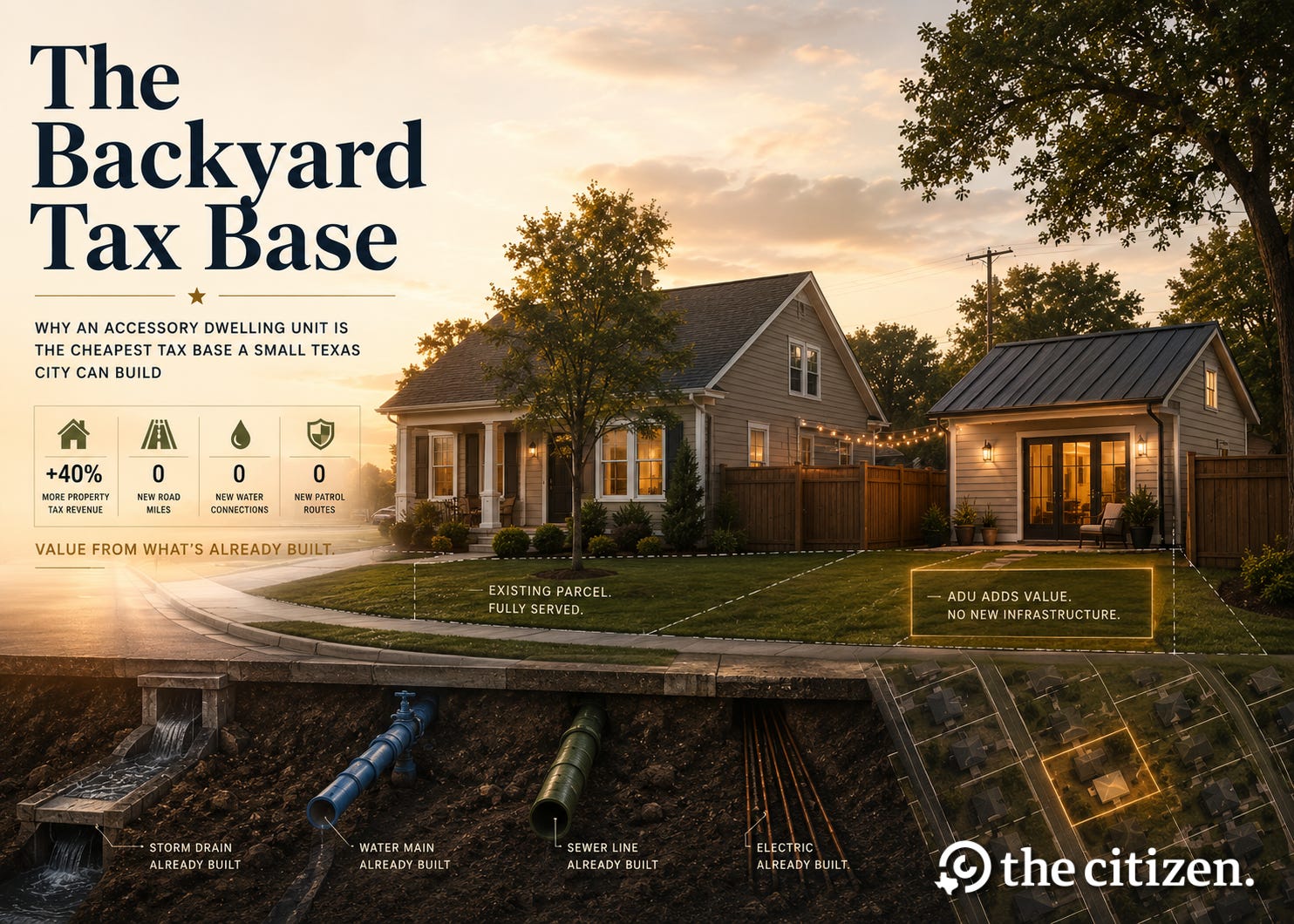
Two parcels on the same street. Same lot size. Same setbacks, same drainage, same fire response time, same water main running under the same easement. One has a 2,200-square-foot house on it. The other has a 2,200-square-foot house and a 700-square-foot accessory dwelling unit in the rear yard — a converted garage apartment, a casita, a granny flat. The word does not matter. What matters is that the second parcel generates roughly 40 percent more in property tax revenue than the first, without adding a single linear foot of road, a single new water connection, or a single new patrol route for the city to maintain.
For most cities, those two parcels are treated the same in zoning. One is allowed by right. The other requires a special exception, a public hearing, a variance, or is prohibited outright.
That is a policy choice, and most cities make it without ever framing it as one.
A Quick Working Definition: Breakeven Value
Every residential parcel inside a city has a number attached to it that’s rarely discussed in public. Call it the parcel’s breakeven value — the property value at which the parcel’s annual tax revenue covers the parcel’s share of the city services it consumes. Below that number, the parcel is being subsidized by some other land use. Above it, the parcel is a net contributor to the General Fund.
This is not a controversial concept. It’s the operating logic behind fiscal impact analysis, the Government Finance Officers Association’s (GFOA) guidance on long-range financial planning, and the cost-of-community-services methodology that the American Farmland Trust formalized in the 80s and that has been replicated in more than 100 peer-reviewed studies since. The Lincoln Institute of Land Policy has been publishing on it for two decades. The American Planning Association teaches it in its AICP credentialing materials. It’s important - How much does it cost a city to service a parcel A or B?
The finding is not new and it is not in serious dispute among people who do this work for a living: in the median U.S. community, residential land use costs about $1.15 to $1.16 in services for every $1.00 of property tax revenue it generates. Commercial and industrial land use comes in at about $0.30 on the dollar. Agricultural and open-space land comes in at about $0.37.
In plain English, the typical single-family neighborhood does not pay for itself. It is carried by commercial property, by sales tax, by state aid, by intergovernmental transfers, or by the assumption that future growth will eventually balance the books.
That is the math the breakeven concept is built on.
Why the Standard Response Does Not Work
Most cities, when confronted with the gap between residential revenue and residential service costs, respond by approving more residential development. The logic is intuitive: more rooftops, more taxable value, more revenue. The problem is that the additional residential parcels arrive with their own service costs attached — new road miles to maintain, new water and sewer lines to operate, new fire response zones to staff, new parks to mow, new street trees to replace every twenty-five years (if they make it that long).
Fact: A new subdivision doesn’t improve the city’s residential fiscal ratio. It scales it. The same $1.16-of-services-per-$1.00-of-revenue problem applies to the new parcels, except now there are more of them.
This is the part that rarely gets said out loud in the development conversation. Truthfully, it’s just not important to the land owner or the developer.
If a city wants to improve the fiscal productivity of its residential land base, the most efficient move is not to build more residential parcels. It is to extract more value from the residential parcels it already has — without adding the infrastructure footprint that makes residential expensive to serve in the first place.
That is what an Accessory Dwelling Unit (ADU) does.
What an ADU Actually Changes
An accessory dwelling unit is a small, secondary residential unit built on a lot that already contains a primary single-family home. It can be a detached cottage in the rear yard, a converted garage with a kitchen and bathroom, a basement apartment, or an attached addition with its own exterior entrance. Texas calls it an ADU. California calls it an ADU. The IRS calls it a separately rentable dwelling. Your grandmother probably calls it a mother-in-law suite.
What makes it fiscally distinct from a new subdivision lot is the infrastructure that is already in place. The road frontage is paid for. The water main is paid for. The sewer collector is paid for. The fire response zone, the patrol route, the school catchment, the streetlight on the corner — all paid for. Every one of those costs is already on the city’s books, fixed, sunk, and being depreciated whether the ADU exists or not.
The marginal cost of serving an ADU is not zero. It exists. Trash pickup increases. Water and wastewater treatment volume increases. Schools may add a student. But the marginal cost is dramatically lower than the marginal cost of serving a new subdivision parcel, because the city is not building any new linear infrastructure to do it.
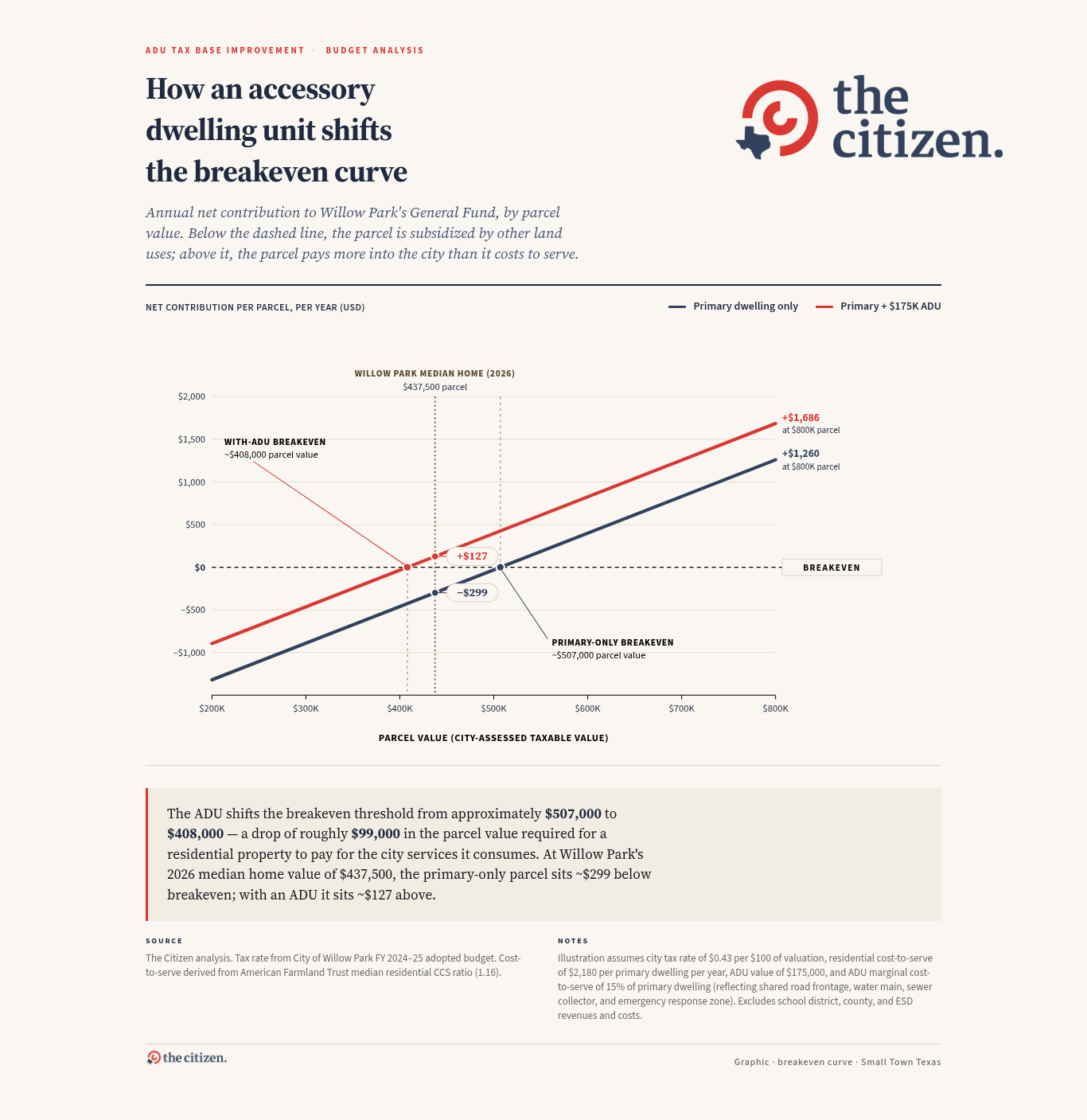
On the other hand, the marginal revenue, is significant. A 700-square-foot ADU built to current Texas construction standards typically appraises somewhere between $120,000 and $200,000 depending on finish level, location, and rental potential. At Willow Park’s current city ad valorem rate of $0.43 per $100 of valuation, a $175,000 ADU adds roughly $753 in city property tax revenue per year, every year, indefinitely.
That is the entire concept. Revenue up. Service load barely changed. Breakeven value of the parent parcel falls.
The Willow Park Math
Willow Park’s median single-family home is valued at approximately $437,500. At the city’s current tax rate of $0.43 per $100, that home generates about $1,881 in city property tax revenue per year. (The total tax bill the homeowner sees is several times that — Aledo ISD, Parker County, Weatherford College, and Emergency Services District No. 1-A all also draw against the parcel — but the math here is about the city’s General Fund specifically.)
Add a $175,000 ADU to the same parcel. The city’s revenue from that single property rises from $1,881 to approximately $2,634 per year. A 40 percent increase from the city’s perspective, generated entirely on infrastructure the city has already built and is already paying to maintain.
Now scale the math. If 100 of Willow Park’s existing single-family parcels added an ADU at that value, the city’s annual ad valorem revenue would rise by roughly $75,300, with no new road miles, no new utility extensions, and no new debt issuance. Across 500 parcels — a meaningful but plausible long-run figure for a city of this size — the increment is in the neighborhood of $376,000 a year. That is enough to cover a full additional patrol officer, two-thirds of an annual street overlay program, or a meaningful chunk of the city’s long-tail capital reserve.
The school district, the county, and the ESD all see proportional revenue increases from the same parcels, with similarly small marginal service costs. The math compounds across the taxing units.
That is the fiscal case. It is not complicated. It is mostly arithmetic.
Plotted across the city’s full range of residential parcel values, the relationship looks like this:
What Texas Did, and Didn’t Do, in 2025
The 89th Texas Legislature spent the 2025 session debating a package of statewide housing reform bills. Four passed and were signed into law by the Governor, effective September 1, 2025:
SB 15 allows minimum lot sizes as small as 3,000 square feet in new subdivisions on five acres or more — but only in cities with populations above approximately 150,000 in counties of 300,000 or more. SB 840 allows mixed-use and multifamily housing by right in commercial zones — again, in large cities only. SB 2477 creates a fast-track for office-to-housing conversions in major Texas markets. HB 24 tightened public notice and zoning protest procedures statewide.
None of these apply to Willow Park. The city is too small.
The one bill that would have applied to every Texas city — SB 673, the statewide ADU preemption bill — passed the Senate 27 to 3 in April 2025 and was placed on the General State Calendar in the House on May 26, where it ran out the clock before the regular session ended. It died. ADU regulation in Texas, as a result, remains a city-by-city decision.
For a city of Willow Park’s size, this is not a constraint. It is an open question with a default answer.
The Second Regulator
City zoning is one layer - the layer most public conversation about housing density assumes is the binding constraint. It usually isn’t.
Most residential subdivisions in Texas were platted with recorded deed restrictions. CC&Rs in shorthand - that operate independently of city zoning. Private regulatory contracts that run with the land. Every owner is bound by them. They are enforced by the HOA, not the city, and they can restrict ADUs even where the city allows them by right.
Texas’ governing framework for HOAs resides in Chapter 209 of the Texas Property Code — the Texas Residential Property Owners Protection Act. Chapter 209 sets procedural rules for how HOAs must operate, but it does not, with narrow exceptions, tell them what they can or cannot restrict. Notably, the substantive restrictions live in the recorded covenants each subdivision adopts.
That is the layer city zoning doesn’t govern.
For Instance, if Willow Park adopted the most permissive ADU ordinance in Texas tomorrow, homeowners in subdivisions whose CC&Rs prohibit accessory dwellings would still be prohibited from building them. The city’s permission does not override the private contract. To change that outcome, the HOA’s covenants would have to be amended — typically requiring a supermajority of property owners (if managed locally).
The Texas Legislature has overridden HOA covenants before, narrowly, on specific topics. Ch. 202 now lists what HOAs can no longer prohibit: solar energy devices, the U.S. and Texas flags, religious displays (§ 202.018), xeriscaping and rain barrels, standby generators, political signs, and security cameras. Each was a deliberate legislative override of private deed restrictions.
That is the gap in the statewide ADU debate. The argument for SB 673 rested on protecting homeowners from city restrictions. It didn’t touch HOA covenants. In most of Texas’s residential housing stock, the entity restricting the homeowner is not the city.
For Willow Park, the practical implication is that an ADU ordinance is a smaller, more bounded decision than rhetoric suggests. The fiscal math applies on the parcels where the city’s authority reaches — larger, older lots, unrestricted areas, and subdivisions whose covenants permit or are silent on ADUs.
What a Small Texas City Can Actually Do
A P&Z commissioner reading this could worry that loosening ADU rules turns every neighborhood into duplexes. The honest answer is: it won't, most of the subdivisions in Willow Park and similar Texas Edge Cities where that fear lives are already bound by HOA covenants that prohibit it.
Furthermore, the technical decisions involved in writing an ADU-friendly zoning code are well documented. The American Planning Association, ULI, AARP (which has been one of the most active national advocates for ADU legalization, largely because of aging-in-place use cases), and the Texas Municipal League all publish model ordinance language and policy guidance.
The basic framework, in operator terms, looks like this:
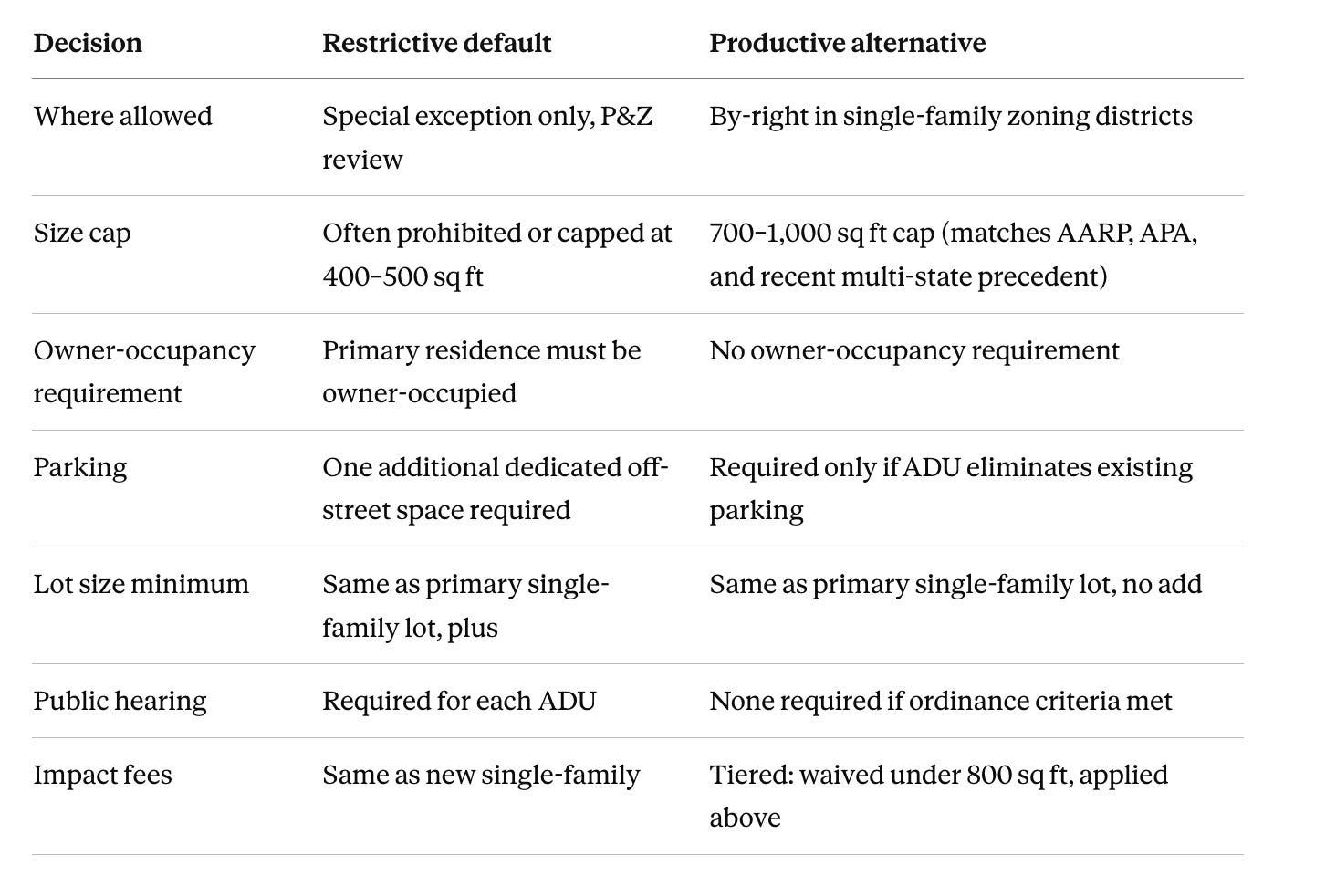
None of this is exotic. It is settled best practice in the design and planning world. It’s also entirely within the legal authority of a Texas general-law or home-rule city to adopt without state permission.
The Tradeoffs That Deserve More Airtime
This is not a no-cost decision, and pretending it is undermines the case for it.
The legitimate concerns are: drainage capacity on lots that were platted under earlier coverage assumptions; on-street parking pressure on narrow residential streets; emergency vehicle access on lots that may now contain two structures and four cars; the cumulative effect on neighborhood character in areas where homeowners purchased a property based on a specific zoning expectation. These are real engineering and planning questions. The right response is to address them in the ordinance — through coverage caps, parking standards triggered at unit sizes, setback requirements, and building code enforcement — not ignore them.
There is also the HOA layer. Most Texas residential subdivisions are governed by private deed restrictions that operate independently of city zoning. Even if a city allows ADUs by right, an HOA can prohibit them by covenant, and SB 673 — had it passed — would not have changed that. ADU policy at the city level affects what the city allows.
THE DEMOGRAPHICS
ADU occupants in single-family neighborhoods are concentrated in three patterns: aging parents on adult children's lots, downsizing residents staying in the neighborhood they already lived in, and small-household professionals or returning adult children. AARP found only 12% of ADUs operating as short-term rentals; long-term housing dominated. AARP's 2024 national survey added context on use case: 62% of adults said they would consider building an ADU for a loved one needing care, and one in four homeowners over 50 have considered building one on their property.
The apartment mental model — high turnover, large household sizes, anonymous occupants, owner offsite — does not describe the typical ADU.
The honest framing is this: the fiscal upside is real, the engineering concerns are real, but regulations need a sufficient nexus to a legitimate public purpose.
The Close
A small Texas city does not need a new subdivision to grow its tax base. It needs to allow the parcels it already has to carry more weight. Infill, tax dollar produced vs. tax dollar consumed - basic fiscal literacy. The infrastructure is paid for. The roads exist. The water main is in the ground. The fire trucks are already on call.
The cheapest tax base a city can build is the one already sitting behind every house in town.
Whether to let it exist is a local question, and right now, in Willow Park and most other small Texas cities, the answer is still being made by default rather than by deliberation.
The math is settled. The deliberation is in the ordinance.
★★★